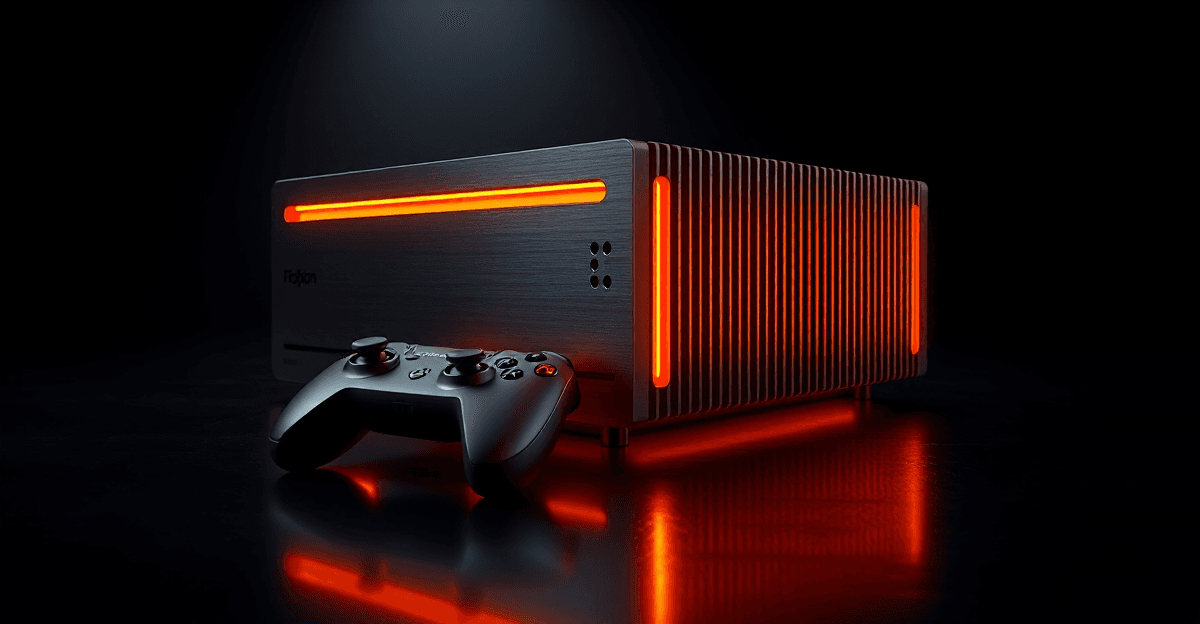
Valve Steam Machine Returns: What the 2026 Release Window Means
After years of near-silence, Valve has quietly updated the product status pages for the Steam Machine, Steam Frame, and Steam Controller to "coming soon," signaling a pre-June 2026 ship date that has sent ripples through both the gaming community and, perhaps less obviously, the enterprise AI hardware world. This is not a minor product refresh announcement. Valve says it still plans to ship the Steam Machine in 2026, and that commitment — backed by visible catalog updates tracked through SteamDB — represents a meaningful inflection point in how purpose-built consumer hardware is being conceived, designed, and deployed.
What makes this moment significant is not just the nostalgia factor or the gaming press headlines. The original Steam Machine experiment, launched in 2015, stumbled under the weight of fragmented hardware partnerships, a confused value proposition, and a market that was not ready for Linux-based gaming at scale. That Valve is returning to this territory in 2026 — with what appears to be a tighter, more vertically integrated hardware strategy — suggests the company has spent a decade learning lessons that extend well beyond gaming. Community analysis of SteamDB tracking data suggests Valve is planning a phased hardware rollout rather than a single splashy launch event, a strategy that mirrors how enterprise AI infrastructure is increasingly deployed: incrementally, with feedback loops built in from day one.
For technology leaders and AI practitioners, the 2026 release window is worth watching not because of frame rates or controller ergonomics, but because the Steam Machine represents a live testbed for AI-optimized, purpose-built consumer hardware architectures. The decisions Valve makes about silicon selection, memory bandwidth, thermal design, and OS-level optimization will generate real-world performance data at consumer scale — data that will eventually inform enterprise AI hardware procurement decisions in ways that laboratory benchmarks simply cannot replicate.
Steam Frame and Controller: The AI-Integrated Hardware Stack
The Steam Frame is generating particular interest among hardware architects, and for good reason. Rather than positioning it as a simple chassis or enclosure, Valve appears to be designing the Steam Frame as a modular hardware platform built for iterative upgrades. This is not a trivial distinction. Modularity and composability are foundational principles in AI infrastructure design — the same philosophy that drives hyperscaler data center architectures, where workloads can be shifted across compute nodes without rebuilding the entire stack. Applying that thinking to a consumer device is ambitious, and the 2026 Steam Frame will be a meaningful proof of concept for whether modular hardware design can survive contact with mass-market economics.
The return of the Steam Controller raises equally interesting questions, particularly for those working on adaptive input and human-computer interaction. The original Steam Controller was ahead of its time in attempting to replace traditional analog sticks with dual trackpads, and it attracted a dedicated user base that appreciated its configurability. In 2026, the more pressing question is whether Valve has integrated machine learning into the input layer — specifically, whether the controller can adapt control schemes in real time based on user behavior patterns. Adaptive input personalization is an active area of AI research, and a consumer controller shipping at scale would be an extraordinary deployment surface for that kind of edge inference.
From a RevolutionAI perspective, what the machine-steam-frame ecosystem most closely resembles is a vertically integrated hardware-software stack — a model that has already proven its value in AI accelerator design, where companies like NVIDIA and Google have demonstrated that controlling both the silicon and the software stack produces dramatically better performance outcomes than relying on general-purpose commodity hardware. HPC hardware design principles — modularity, thermal efficiency, workload-specific optimization — are no longer confined to data centers. They are crossing over into consumer gaming devices, and the Steam Machine ecosystem is the most visible current example of that transition. Our AI consulting services team has been tracking this convergence closely, because the enterprise implications are substantial.
Memory and Storage Shortages: The Hidden Risk to the 2026 Launch
No analysis of the Steam Machine's 2026 prospects would be complete without a frank discussion of the supply chain environment Valve is navigating. Industry analysts have been sounding alarms about what some are calling "rampocalypse" — a confluence of DRAM and NAND supply shortages driven by surging demand from AI data center buildouts, geopolitical disruptions in semiconductor manufacturing, and the cyclical nature of memory markets. Memory shortages and storage shortages are not hypothetical risks for a 2026 hardware launch; they are active constraints that every hardware manufacturer is working around right now.
The competitive dynamics here are particularly challenging. AI inference workloads at hyperscale are consuming high-bandwidth memory at a rate that was difficult to forecast even two years ago. Every H100 cluster, every inference farm, every edge AI deployment pulls from the same global pool of DRAM and NAND that Valve needs to build Steam Machines at consumer-friendly price points. This puts consumer gaming hardware in direct competition with data center demand — a competition that, historically, data centers win on margin. Valve's ability to secure favorable component pricing and adequate supply volumes will be a significant determinant of whether the early 2026 release window holds and whether production volumes meet market demand.
For hardware-dependent AI projects of any kind, this supply chain reality is a structural risk that needs to be built into project planning from the start, not treated as an anomaly to be managed reactively. Procurement intelligence — understanding where components are in the supply cycle, which suppliers have committed capacity, and how to model alternative configurations — is increasingly a core competency for AI hardware projects. AI-driven supply chain forecasting tools are now sophisticated enough to provide meaningful lead-time predictions and risk signals, and organizations that are not using them are operating with an avoidable blind spot. If your team is building hardware-dependent AI roadmaps for 2026, this is precisely the kind of strategic complexity where engaging experienced AI consulting services pays for itself quickly.
Why AI Consulting Firms Are Watching the Steam Machine Closely
The Steam Machine is not just a gaming product. Its architecture decisions — GPU selection, memory bandwidth, OS-level optimizations, thermal envelope — will directly influence how AI workloads perform on edge and consumer devices for the next several years. When Valve chooses a GPU for the Steam Machine, they are implicitly making a statement about which inference performance tier is viable at consumer price points. When they optimize SteamOS for that GPU, they are generating a body of Linux-native driver and runtime optimization work that the broader AI community can build on.
SteamOS as a Linux-based platform is particularly significant for the AI deployment landscape. The vast majority of enterprise AI infrastructure runs on Linux, but edge AI deployment has historically been constrained by the dominance of Windows on consumer and small-business hardware. A successful Steam Machine ecosystem — with an active developer community, optimized runtimes, and a large installed base — would meaningfully expand the surface area for edge AI model deployment outside the traditional Windows ecosystem. For AI practitioners who have been frustrated by the friction of deploying models on Windows-first edge devices, this is a genuinely interesting development.
Valve's willingness to return to the Steam Machine after the original product's struggles also offers a case study in product iteration mindset that resonates with how RevolutionAI approaches POC development. The original Steam Machine was not a failure in the sense of being a bad idea — it was a product that arrived before the ecosystem was ready to support it. Valve learned, iterated internally for nearly a decade, and is now returning with what appears to be a more coherent strategy. For AI consultants managing long development cycles with shifting technical constraints, this is a recognizable pattern: the ability to maintain stakeholder confidence through extended iteration periods while continuing to refine the underlying architecture is a skill that separates successful AI programs from abandoned ones.
Gaming Hardware as an AI Proof of Concept: Lessons for Enterprise
The history of consumer gaming hardware as a proving ground for enterprise AI capabilities is well-documented. The GPU is the canonical example: originally designed to accelerate polygon rendering for video games, it became the foundational compute primitive for deep learning training and inference. The path from gaming GPU to AI accelerator was not a straight line — it required years of software ecosystem development, architectural refinements, and workload-specific optimizations — but the gaming market provided the volume economics that made those GPUs cheap enough to experiment with at scale.
The Steam Machine's real-time rendering pipeline shares more architectural DNA with AI inference pipelines than most enterprise decision-makers realize. Both workloads demand high levels of parallelism, low-latency memory access, and deterministic performance under variable load conditions. The optimization work that game developers do to hit consistent frame rate targets — managing memory hierarchies, minimizing pipeline stalls, batching operations efficiently — is structurally similar to the optimization work that AI engineers do to hit inference latency targets. When gaming hardware benchmarks improve, it is often a leading indicator that the underlying compute primitives are maturing in ways that will benefit AI workloads within 12 to 24 months.
RevolutionAI's POC development practice applies the same rapid-prototyping discipline that Valve has demonstrated across its hardware programs: define constraints early, validate on real hardware as quickly as possible, and iterate fast based on empirical results rather than theoretical projections. For enterprises evaluating AI hardware investments, this means treating gaming hardware benchmarks as a free and frequently updated signal about accessible compute performance curves. The Steam Deck, Valve's current handheld, has already demonstrated that consumer-grade AMD silicon can run meaningful AI inference workloads. The Steam Machine will push that envelope further, and the benchmark data it generates will be directly relevant to enterprise edge AI hardware decisions.
No-Code and Managed AI Services in a Hardware-First World
As purpose-built AI hardware like the Steam Machine ecosystem moves toward mainstream availability, one of the most significant shifts will be in the barrier to running local AI models. Today, deploying a capable language model or computer vision system on local hardware requires meaningful technical expertise — understanding quantization, runtime selection, memory management, and hardware-specific optimization flags. As hardware becomes more capable and more purpose-built, that barrier drops, but it does not disappear. It shifts from "can this hardware run the model" to "how do I configure the stack to run it efficiently."
No-code AI platforms need to evolve in response to this shift. A no-code platform that generates a model deployment configuration optimized for a generic cloud GPU is not well-positioned to serve users deploying on a Steam Machine or similar edge device. Hardware-specific optimization — ensuring models are quantized appropriately, runtimes are selected correctly, and memory allocation is tuned for the target device's bandwidth characteristics — needs to be abstracted away from the end user without being ignored by the platform. This is a non-trivial engineering challenge, and it is one that the no-code AI ecosystem has not fully solved yet.
Managed AI services become critical in this environment precisely because the heterogeneity of hardware targets is increasing, not decreasing. Organizations that lack in-house expertise to configure AI workloads across a mix of cloud instances, on-premises servers, and edge devices like the Steam Machine need a partner who can manage that complexity on their behalf. RevolutionAI's managed AI services are designed for exactly this scenario — teams that want to capitalize on new hardware capabilities without building and maintaining the deep technical expertise required to do it themselves. As the 2026 hardware wave arrives, the gap between organizations that have that support and those that do not will widen quickly.
Actionable Takeaways: Preparing Your AI Strategy for the 2026 Hardware Wave
The convergence of Valve's Steam Machine comeback, the broader 2026 consumer hardware release cycle, and the ongoing maturation of edge AI capabilities creates a specific set of strategic decisions that technology leaders should be making now, not in Q3 2026 when the hardware is already shipping.
Audit your AI workloads for edge-deployment readiness. The 2026 hardware landscape will make local inference significantly more viable across a wider range of use cases. If your current AI workloads are architected exclusively for cloud deployment, now is the time to assess what it would take to run them on edge hardware — and whether doing so would improve latency, reduce operating costs, or open new deployment scenarios. This audit does not need to be exhaustive; a focused assessment of your highest-value workloads is sufficient to identify the most promising opportunities.
Build supply chain resilience into hardware-dependent AI projects. Memory shortages and storage shortages are structural features of the 2026 component market, not temporary anomalies. If your AI roadmap depends on specific hardware configurations shipping on a specific timeline, you need contingency planning that accounts for component availability risk. This means identifying alternative hardware configurations, building relationships with multiple suppliers, and using AI-driven forecasting tools to monitor supply signals. Organizations that treat this as someone else's problem will find themselves making reactive decisions under time pressure.
Monitor SteamDB and Valve announcements as a hardware capability signal. This may sound like unusual advice for enterprise AI strategy, but it is genuinely useful. SteamDB provides near-real-time visibility into Valve's hardware and software development activity, and Valve's consumer hardware decisions are leading indicators of what compute capabilities will be accessible at scale within 12 to 24 months. Following this signal costs nothing and provides meaningful context for enterprise AI hardware procurement planning.
Finally, if your organization is building AI capabilities for the 2026 horizon and you do not have a clear view of how the hardware landscape will affect your roadmap, this is the right moment to engage support. Whether that means bringing in AI consulting services to assess your strategic position, engaging managed AI services to handle operational complexity, or accessing specialized talent through our freelance marketplace, the window to get ahead of the 2026 hardware wave is now — not after the Steam Machine ships and the market has already adjusted.
Conclusion: The Steam Machine as a Bellwether for the AI Hardware Era
Valve's decision to bring back the Steam Machine in 2026 is, on the surface, a story about gaming. But the deeper story is about what happens when hardware design philosophy — modularity, workload-specific optimization, vertically integrated software stacks, iterative deployment — converges across the gaming and AI infrastructure worlds. The Steam Machine is not just a living room PC. It is a proof of concept for a class of purpose-built edge hardware that will define how AI models are deployed outside of data centers for the next decade.
The supply chain risks are real. The technical ambitions are significant. The ecosystem dependencies are complex. But these are precisely the characteristics of every meaningful AI hardware transition that has come before — from the first CUDA-enabled GPUs to the first TPU deployments to the first wave of purpose-built inference accelerators. Each of those transitions looked uncertain from the outside and inevitable in retrospect.
Technology leaders who are paying attention to the Steam Machine's 2026 trajectory — its architecture decisions, its supply chain navigation, its developer ecosystem development — are gathering signal that their competitors who are only reading gaming news are missing entirely. At RevolutionAI, we believe the organizations that will lead in AI over the next five years are the ones building that kind of cross-domain awareness into their strategy today. If you are ready to think about what the 2026 hardware wave means for your AI program, we are ready to help.
Frequently Asked Questions
What is the Valve Steam Machine and when is it coming out?
The Valve Steam Machine is a purpose-built gaming PC designed to run Steam games through a Linux-based operating system, originally launched in 2015 before being discontinued. Valve has updated its product status pages to 'coming soon,' signaling a return with a pre-June 2026 release window. The 2026 version is expected to feature a more vertically integrated hardware strategy, learning from the fragmented approach that hampered the original launch.
How is the 2026 Valve Steam Machine different from the original 2015 version?
The original 2015 Steam Machine struggled due to fragmented hardware partnerships, a confusing value proposition, and a market not yet ready for Linux gaming at scale. The 2026 version appears to adopt a tighter, vertically integrated hardware-software strategy, with a phased rollout approach rather than a single launch event. Valve also seems to be incorporating modular design principles through the accompanying Steam Frame, making the new ecosystem more adaptable and upgradeable over time.
What is the Steam Frame and how does it work with the Steam Machine?
The Steam Frame is a modular hardware platform designed to work alongside the Valve Steam Machine as an upgradeable chassis or enclosure component. Rather than functioning as a simple case, it appears built around composability principles that allow iterative hardware upgrades without rebuilding the entire system. This modular approach mirrors enterprise-grade infrastructure design and positions the Steam Frame as a long-term investment rather than a disposable peripheral.
Why should I buy a Valve Steam Machine instead of a traditional gaming PC or console?
The Valve Steam Machine offers a middle ground between the open ecosystem of a PC and the plug-and-play simplicity of a console, giving users access to the full Steam library without building a custom rig. The 2026 version's modular design through the Steam Frame means hardware components can be upgraded over time, potentially extending the device's useful lifespan compared to fixed-spec consoles. For buyers already invested in the Steam ecosystem, it provides a living-room-friendly experience without sacrificing game library breadth.
When will the new Steam Controller be available and what new features does it have?
The new Steam Controller is expected to ship alongside the Valve Steam Machine within the pre-June 2026 release window, based on updated product status pages tracked through SteamDB. The original controller was notable for its dual trackpad design replacing traditional analog sticks, and the 2026 version may incorporate machine learning to adapt control schemes in real time based on individual user behavior. If Valve has integrated edge AI inference into the input layer, it would represent a significant leap forward in adaptive, personalized gaming peripherals.
Is the Valve Steam Machine worth waiting for in 2026?
For PC gamers who want a living-room gaming setup with access to the full Steam library, the 2026 Valve Steam Machine is worth monitoring closely given Valve's decade of lessons learned since the original launch. The combination of a modular Steam Frame, a potentially AI-enhanced Steam Controller, and a more focused hardware strategy suggests a more compelling product than its predecessor. However, buyers with concerns about Linux game compatibility should track Valve's continued investment in Proton, which has dramatically improved Windows game support on Linux since 2018.