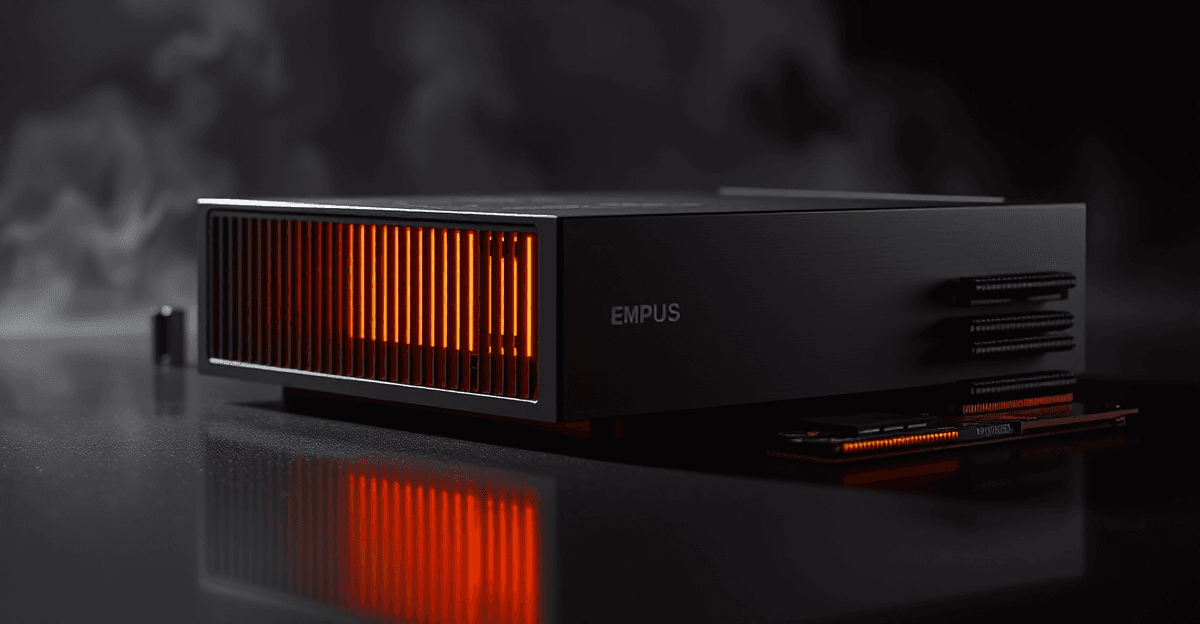
The Steam Machine Is Back: What the 2026 Announcement Really Means
Valve's confirmed 2026 release of the Steam Machine, controller, and Steam Frame VR isn't just a gaming headline — it's a signal that the lines between consumer electronics and professional compute infrastructure are dissolving faster than most enterprise leaders realize. After years of dormancy following the original Steam Machine's underwhelming 2015 debut, Valve has returned with a more mature hardware ecosystem strategy, one that reflects hard lessons learned about ecosystem coherence, supply chain transparency, and modular design. For enterprise CIOs and AI infrastructure architects, the story buried inside this gaming announcement is worth reading carefully.
What makes the 2026 announcement particularly instructive is how Valve handled its communication missteps along the way. A deleted blog post — which briefly surfaced and then disappeared before Valve republished a revised version — sparked speculation and frustration across the gaming community. Rather than doubling down on silence, Valve addressed the supply chain pressures candidly, acknowledging that challenges caused by current memory shortage conditions were affecting their timelines. That kind of transparent hardware communication is rare, and it reframes the Steam Machine story from a consumer product launch into a masterclass in managing stakeholder expectations under real-world supply constraints.
The deeper implication for enterprise teams is this: the Steam Machine and its companion hardware are being positioned as hybrid compute platforms. Despite pessimistic-sounding headlines about delays and supply shortages, Valve is building something that blurs the boundary between gaming systems and professional AI workstations. That convergence deserves serious attention from anyone planning AI infrastructure investments through 2026 and beyond.
Memory Shortages & Supply Chain: Challenges Caused by Current Market Pressures
The challenges caused by current memory shortage conditions aren't unique to Valve — they're a systemic constraint reshaping hardware procurement across every sector. HBM3 and GDDR7 supply tightness, driven largely by AI training cluster demand from hyperscalers, has created ripple effects that reach all the way down to consumer gaming hardware and edge AI devices. IDC projected that enterprise AI hardware spending would exceed $150 billion globally by 2026, and that demand is colliding directly with a constrained supply of high-bandwidth memory components that both gaming GPUs and AI inference accelerators depend on.
For enterprise AI teams, the current memory shortage is not an abstract supply chain problem — it's a procurement reality that is already stretching GPU cluster delivery windows from weeks into months. Organizations planning proof-of-concept AI deployments have found themselves waiting on hardware that was ordered well in advance, only to discover that lead times had quietly doubled. The same silicon scarcity affecting Valve's Steam Machine timeline is affecting the NVIDIA H100 and AMD Instinct allocations that AI infrastructure architects are counting on for 2026 rollouts. Understanding this dynamic is foundational to any realistic AI hardware roadmap.
What Valve's situation illustrates is that even well-resourced hardware companies with established supply chain relationships are not immune. CIOs who treat GPU and memory procurement as a just-in-time exercise are increasingly exposed. Our AI consulting services team works with enterprise clients to build procurement buffers and alternative sourcing strategies directly into their AI infrastructure roadmaps — because in 2026, the organizations that planned for supply volatility will be the ones that ship on time.
Steam Frame VR Confirmed for 2026: Implications for Spatial AI & Enterprise XR
Steam Frame VR's confirmed 2026 release puts Valve squarely inside the spatial computing race alongside Apple Vision Pro and Meta Quest's enterprise offerings. But unlike Apple's premium-priced closed ecosystem and Meta's social-media-adjacent positioning, Valve is entering the spatial computing market with an open, developer-friendly stack that has always been its competitive differentiator. For enterprise teams building spatial AI applications — digital twins, immersive HPC data visualization, remote collaboration environments — the Steam Frame VR represents a potentially compelling and cost-competitive platform.
The spatial AI use cases emerging in 2026 are not trivial. Manufacturing companies are deploying digital twin environments to simulate factory floor configurations in real time. Healthcare systems are piloting immersive surgical planning tools that overlay AI-generated anatomical models on physical space. Energy companies are using VR-integrated HPC visualization to interpret seismic data sets that would be incomprehensible on a flat screen. These applications require exactly the kind of tightly integrated controller, compute, and display stack that Valve is assembling — and the Steam Frame VR's confirmed specifications suggest it will be capable of handling the edge inference workloads these use cases demand.
Enterprise technology directors should resist the temptation to categorize the Steam Frame VR as a gaming peripheral and nothing more. The hardware stack Valve is building — unified memory architecture, high-throughput I/O, real-time spatial rendering — maps directly onto the requirements for edge AI interface layers in distributed enterprise environments. Organizations that begin evaluating Steam Frame VR as an enterprise XR platform now, before its 2026 release, will be better positioned to integrate it into their AI infrastructure roadmaps without scrambling at launch.
HPC Hardware Design Lessons Hidden Inside Valve's Steam Ecosystem Strategy
Valve's modular approach to the 2026 hardware lineup — separating the Steam Machine, controller, and Steam Frame into distinct but interoperable units — is not an accident of product design. It reflects a deliberate architectural philosophy that mirrors best-practice HPC hardware design principles for scalable AI systems. In high-performance computing, the ability to upgrade or replace individual components — compute nodes, interconnects, storage layers — without rebuilding the entire stack is what separates resilient infrastructure from brittle monoliths. Valve is applying that same logic to consumer hardware, and enterprise architects should take note.
RevolutionAI's HPC hardware design engagements consistently surface the same pattern: organizations that deploy AI infrastructure as monolithic, tightly coupled systems pay a significant cost in flexibility and performance as their workloads evolve. When the compute layer, I/O subsystem, and user interface are decoupled and independently scalable, teams can optimize each layer for its specific workload without creating bottlenecks elsewhere. This is precisely the architectural principle that Valve's phased, modular release strategy embodies — and it's a principle that translates directly into enterprise AI infrastructure design.
The phased release strategy itself is worth studying as a project management model. Rather than attempting a simultaneous launch of the Steam Machine, controller, and Steam Frame VR — which would have amplified the supply chain risks associated with the current memory shortage — Valve is sequencing releases to manage dependencies and reduce single points of failure. For enterprise teams rolling out AI infrastructure, this staged approach is far more robust than the "big bang" deployment model that so often leads to stalled POC launches and overrun budgets. Our POC development team builds this kind of phased delivery discipline into every engagement from day one.
From Gaming Systems to AI Workstations: The Convergence Enterprise Leaders Must Watch
The hardware specifications of modern gaming systems like the Steam Machine are no longer separable from the specifications of professional AI workstations — at least not at the edge inference tier. AMD's latest APU architecture, which is expected to power the Steam Machine, features unified memory architectures that allow the CPU and GPU to share a high-bandwidth memory pool without the latency penalty of discrete memory transfers. That same architectural feature is what makes AMD's Ryzen AI chips viable for on-device LLM inference. The computers electronics categories are converging at the silicon level, and that convergence has real implications for enterprise hardware strategy.
Consider the practical arithmetic: a Steam Machine-class device with an AMD APU delivering 50+ TOPS (tera-operations per second) of AI inference performance, available at consumer price points well below $1,000, represents a fundamentally different cost model for distributed edge AI deployments than purpose-built inference hardware. For enterprises running AI workloads in retail environments, manufacturing floors, or healthcare facilities — where dozens or hundreds of edge nodes are required — the cost differential between consumer-grade AI-capable hardware and enterprise-specific inference appliances can reach into the millions of dollars at scale.
Enterprise architects in retail, healthcare, and manufacturing should be monitoring the Steam Machine's hardware stack not as a curiosity but as a legitimate edge AI node candidate. The same real-time ray tracing capabilities that render photorealistic game environments can power AI-driven spatial awareness systems. The same low-latency I/O that handles gaming controller inputs can process sensor streams from industrial IoT devices. The convergence is real, it's accelerating, and the organizations that recognize it early will have a meaningful cost and deployment speed advantage over those that don't.
AI Security & No-Code Rescue: Protecting Next-Gen Hardware Ecosystems
Every new generation of connected hardware expands the attack surface that enterprise security teams must defend. The Steam Machine and Steam Frame VR, as networked, software-updatable devices with rich I/O capabilities, introduce the same category of AI security vulnerabilities that RevolutionAI's security team encounters in every new IoT and edge hardware generation. Valve's open ecosystem philosophy — which is genuinely valuable for developer flexibility — also means that the security posture of any given deployment depends heavily on how the operator configures and manages the stack. That responsibility doesn't disappear just because the hardware shipped from a reputable vendor.
For enterprises adopting modular AI hardware stacks inspired by Valve's architecture, the security lesson is unambiguous: zero-trust frameworks must be implemented from the POC stage, not retrofitted after production deployment. The cost of remediating a misconfigured AI pipeline that has been running in production — with live data, integrated workflows, and organizational dependencies built on top of it — is orders of magnitude higher than building security in from the start. Our AI security solutions practice works with enterprise teams to embed zero-trust principles into AI infrastructure design before the first workload goes live, not after the first incident report lands on the CISO's desk.
No-code rescue strategies have emerged as a critical capability for organizations that find themselves with AI pipelines that were deployed quickly — often under competitive pressure — and are now running on hardware configurations that were never properly hardened. Whether the underlying platform is a cloud-based inference cluster or an edge device running on Steam Machine-class hardware, the pattern is consistent: rapid deployment creates configuration debt, and that debt accumulates security risk over time. The good news is that no-code remediation approaches can address many of these misconfigurations rapidly, without requiring a full rebuild of the pipeline — preserving the business value of the deployment while closing the security gaps that threaten it.
Actionable 2026 AI Hardware Strategy: What to Do Before the Steam Machine Lands
The window between now and the Steam Machine's 2026 release is not dead time — it's the most valuable planning period enterprise AI teams will have before the next wave of edge hardware hits the market. The first priority should be auditing your current AI hardware roadmap against the 2026 supply landscape. Challenges caused by current memory shortage conditions will affect procurement lead times for GPU clusters, edge inference devices, and HBM-equipped accelerators alike. Organizations that have not already engaged their hardware vendors about 2026 allocation windows are likely to find themselves at the back of a very long queue.
The second priority is stress-testing your HPC and AI infrastructure against the workload demands that spatial computing and VR-integrated AI workflows will introduce. Steam Frame VR and competing platforms will generate new categories of AI workload — real-time spatial mapping, low-latency inference for gesture and gaze tracking, high-throughput rendering pipelines — that most enterprise AI infrastructure was not designed to handle. Engaging managed AI services partners now to model these workloads and identify infrastructure gaps is far less expensive than discovering those gaps when a spatial AI pilot goes live and performance falls short of expectations.
Finally, use Valve's phased, transparent release strategy as an organizational model. The deleted blog post episode — and Valve's subsequent decision to communicate openly about supply chain challenges rather than maintain an artificial silence — is a reminder that hardware dependency management is as much a communication discipline as a technical one. Enterprise AI programs that communicate hardware dependencies, timeline risks, and contingency plans clearly to internal stakeholders are the ones that maintain organizational trust through the inevitable delays and pivots that complex infrastructure deployments produce. That discipline is what separates successful AI POC launches from the stalled, over-budget programs that never make it to production. If your team needs support building that discipline from the ground up, our team is ready — explore our consulting services to start the conversation.
Conclusion: The Steam Machine as a Mirror for Enterprise AI Strategy
It would be easy to dismiss the Valve Steam Machine story as a gaming industry footnote — interesting for enthusiasts, irrelevant for enterprise technology leaders. That dismissal would be a mistake. What Valve is building in 2026 is a microcosm of the forces reshaping AI and HPC hardware strategy at every level of the market: supply chain volatility driven by memory shortages, architectural convergence between gaming and professional compute, the emergence of spatial AI as a serious enterprise workload category, and the security challenges that come with every new generation of connected, modular hardware.
The enterprise leaders who will navigate 2026 most successfully are those who recognize that the lessons embedded in consumer hardware stories like this one are not separate from their AI infrastructure challenges — they are the same challenges, playing out on a different stage. Modular design, phased deployment, supply chain transparency, zero-trust security, and spatial AI readiness are not gaming industry concepts. They are the defining disciplines of enterprise AI infrastructure in 2026 and beyond.
RevolutionAI exists to help enterprise teams apply exactly these disciplines — from POC development to AI security to managed services — with the speed and precision that the 2026 AI landscape demands. The Steam Machine is coming. The question is whether your AI infrastructure strategy will be ready when it arrives.
Frequently Asked Questions
What is the Valve Steam Machine and how does it differ from a standard gaming PC?
The Valve Steam Machine is a living room-focused gaming computer that runs SteamOS, Valve's Linux-based operating system, and is designed to bridge the gap between console simplicity and PC gaming flexibility. Unlike a standard gaming PC, it is built around Valve's ecosystem, including Steam library access, a dedicated controller, and now companion hardware like Steam Frame VR. The 2026 iteration positions it as a hybrid compute platform capable of supporting both gaming and AI inference workloads.
When is the new Valve Steam Machine releasing in 2026?
Valve has confirmed a 2026 release window for the new Steam Machine, though exact dates have shifted due to supply chain pressures affecting memory component availability. Valve publicly acknowledged that challenges caused by current memory shortage conditions are impacting their hardware timelines. Prospective buyers should monitor Valve's official channels closely, as lead times and availability may vary by region.
Why did the original Steam Machine fail and will the 2026 version be different?
The original Steam Machine struggled in 2015 primarily due to limited SteamOS game compatibility, inconsistent hardware configurations across third-party manufacturers, and strong competition from traditional gaming PCs and consoles. The 2026 version addresses these weaknesses with a more cohesive hardware ecosystem, improved SteamOS maturity, and companion devices like the new Steam controller and Steam Frame VR headset. Valve has also demonstrated greater supply chain transparency this time, which signals a more disciplined product launch strategy.
How does the Valve Steam Machine compare to the Steam Deck?
The Steam Deck is a handheld portable gaming device, while the Valve Steam Machine is a home-based gaming and compute system designed for living room or desktop use. Both run SteamOS and share access to the Steam library, but the Steam Machine targets higher performance workloads and is being positioned as a hybrid platform suitable for AI inference and professional compute tasks. They are complementary products within Valve's broader hardware ecosystem rather than direct competitors.
What are the main buyer concerns about purchasing a Valve Steam Machine in 2026?
The most common concerns include game library compatibility with SteamOS, hardware availability given ongoing memory shortages, and long-term software support from Valve. Supply chain constraints affecting GDDR7 and HBM3 memory components mean that stock may be limited at launch, so early pre-ordering is advisable. Valve's improved transparency around these issues suggests they are better prepared to manage customer expectations than during the 2015 launch.
Does the Valve Steam Machine support VR and what headsets are compatible?
Yes, the 2026 Valve Steam Machine is confirmed to support VR, with Valve's own Steam Frame VR headset announced as a companion device launching in the same release window. The system is also expected to maintain compatibility with existing SteamVR headsets, including the Valve Index. This positions the Steam Machine as a capable spatial computing platform for both gaming and enterprise extended reality applications.