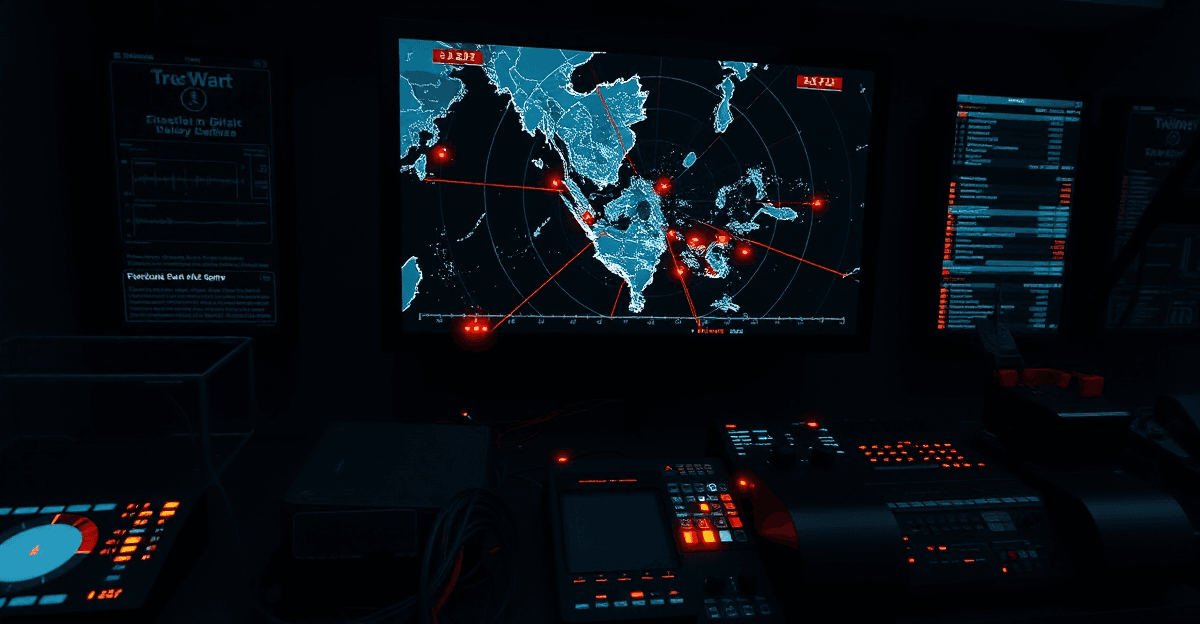
The Taiwan Strait: A Live Stress Test for Military AI
The Taiwan Strait has become one of the most consequential theaters for observing AI defense technology Taiwan analysts and military planners are tracking in real time — and under pressure. Over the past several years, China's People's Liberation Army Air Force has dramatically escalated its incursions into Taiwan's Air Defense Identification Zone (ADIZ). Some single-day events involve dozens of aircraft executing complex, multi-vector approaches. For military analysts, these aren't just political provocations — they are extraordinarily data-rich stress tests for the machine learning systems tasked with interpreting them.
What makes these incursions particularly instructive is not just their frequency, but their variability. Formations shift. Timing changes. New aircraft types are introduced. And then, unexpectedly, there are pauses — including a notable 10-day hiatus in military flights that left analysts puzzled.
Human analysts debated whether the gap signaled diplomatic back-channeling, internal PLA restructuring, or deliberate ambiguity designed to degrade confidence in pattern-based assessments. This is precisely the kind of anomalous behavioral signature that modern AI threat detection systems are purpose-built to flag, contextualize, and escalate. A sudden cessation of activity can be as operationally significant as a surge — and only a system continuously ingesting and modeling baseline behavior can reliably distinguish meaningful silence from routine lulls.
Modern militaries and their defense contractors are increasingly deploying machine learning models capable of doing exactly this: distinguishing routine patrol patterns from coordinated pre-conflict positioning in near real time. These aren't experimental tools. Platforms like Palantir's AI-powered defense intelligence suite and Anduril's autonomous systems are already embedded in operational environments, processing sensor feeds, historical flight data, and contextual intelligence to deliver decision-support outputs at machine speed. The Taiwan Strait, whether anyone intended it or not, has become a live proving ground for the entire field.
AI Surveillance & Airspace Monitoring: How It Works
Behind every real-time airspace threat assessment is a layered architecture of data fusion, inference, and classification. Radar fusion AI sits at the foundation of this stack — aggregating inputs from ground-based radar arrays, airborne early warning platforms, maritime sensors, and satellite-based observation systems into a single, continuously updated operational picture. Rather than requiring human operators to manually correlate feeds from disparate systems, modern military AI surveillance platforms synthesize these inputs automatically, flagging inconsistencies and surfacing anomalies that would be invisible to any single sensor in isolation.
Above the sensor layer, natural language processing tools are playing an increasingly critical role. Signals intelligence intercepts, open-source news aggregation, social media monitoring, and satellite imagery analysis are all being fed into unified threat dashboards. These dashboards give commanders and intelligence officers a multi-domain picture of escalation risk. The ability to correlate a spike in encrypted military communications with unusual aircraft staging activity and an uptick in state media rhetoric — simultaneously, automatically, and in real time — represents a qualitative leap in situational awareness that simply wasn't possible a decade ago.
At the hardware edge, the deployment of edge AI on surveillance platforms is eliminating a latency bottleneck that has historically constrained real-time threat response. When an AI model capable of classifying aircraft type, inferring flight path intent, and recognizing multi-aircraft formation patterns runs directly on the surveillance hardware — rather than sending raw data to a distant cloud server — classification latency drops from seconds to milliseconds. In a domain where engagement decisions can have irreversible consequences, that difference is not incremental. It is categorical.
The Dangerous Gap: Legacy Systems vs. AI-Ready Infrastructure
For all the sophistication of cutting-edge military AI surveillance, the uncomfortable reality is that a significant portion of allied defense infrastructure cannot effectively receive, process, or act on the intelligence these systems generate. Legacy command-and-control networks — many designed in the 1990s or earlier — operate on siloed architectures with proprietary data formats and limited API interoperability. Their processing pipelines were never designed to ingest machine-generated threat intelligence at the speed AI systems produce it. The result is a dangerous asymmetry: the AI sees the threat, but the network cannot respond.
This challenge has a direct parallel in the enterprise technology world, and it's one that RevolutionAI's no-code AI modernization and consulting services are specifically designed to address. Organizations across industries are sitting on brittle, outdated platforms that block the adoption of AI capabilities they urgently need. The solution isn't always a full-stack replacement — sometimes it's intelligent middleware, low-code integration layers, or targeted modernization of the highest-friction bottlenecks. The defense sector's need to rapidly upgrade legacy systems without disrupting operational continuity mirrors exactly the challenge facing enterprises trying to accelerate digital transformation without the luxury of downtime.
The cost of delayed modernization in high-stakes environments is not measured in budget overruns. It's measured in strategic vulnerability. When an adversary's AI systems can process, interpret, and act on battlefield data faster than your own networks can receive it, the technological gap becomes a tactical one. The lesson for both defense planners and enterprise technology leaders is identical: the risk of waiting to modernize is now higher than the risk of moving quickly.
AI Security & Adversarial Machine Learning in Geopolitical Conflict
One of the most underappreciated dimensions of AI defense technology in the Taiwan context is the active, ongoing effort by sophisticated nation-state actors to degrade and deceive the AI systems monitoring them. This isn't theoretical. Spoofed transponder signals designed to misrepresent aircraft identity and position, drone swarm deployments calibrated to overwhelm classification models with ambiguous inputs, and deliberate electromagnetic interference with sensor arrays are all documented tactics in modern gray-zone military operations. The goal is not necessarily to evade detection — it's to poison the data pipeline and erode confidence in AI-generated threat assessments.
This is the domain of adversarial machine learning, and it has moved from academic research to national security imperative with remarkable speed. AI security hardening — including adversarial robustness testing, red-team simulation, and model integrity verification — is no longer a niche concern for AI researchers. It is a foundational requirement for any AI system operating in a contested environment. RevolutionAI's AI security solutions bring this same discipline to enterprise environments, where the adversaries may be financially motivated rather than geopolitically motivated, but the attack vectors are often structurally identical.
For organizations building or deploying AI systems for critical infrastructure — whether that infrastructure is a power grid, a financial settlement network, or a military command system — the architectural implication is clear: zero-trust AI design must be the default. This means assuming that input data has been manipulated, that model outputs will be probed for exploitable patterns, and that the integrity of the entire pipeline — from sensor to inference to action — must be continuously verified. The Taiwan Strait is demonstrating, in real time, what happens when adversaries treat your AI system as an attack surface. Every enterprise operating in a high-stakes environment should be drawing the same lesson.
HPC Hardware & the Processing Demands of Real-Time Defense AI
Tracking hundreds of simultaneous military aircraft sorties — each generating continuous telemetry across radar cross-section, transponder data, thermal signature, and flight dynamics — is a computational challenge of extraordinary scale. Processing petabytes of sensor data in near real time, correlating it against historical flight databases, and generating actionable classification outputs within operationally meaningful timeframes requires purpose-built high-performance computing infrastructure. General-purpose cloud compute, optimized for throughput rather than latency, is often inadequate for the most demanding defense AI inference workloads.
This is driving significant investment in custom HPC hardware design — purpose-built silicon and system architectures optimized for low-latency AI inference at the edge and in hardened tactical environments. Defense contractors and allied governments are increasingly treating HPC hardware capability as a strategic differentiator rather than a commodity procurement decision. The ability to run larger, more accurate AI models faster — with lower power consumption and greater resilience to environmental interference — directly translates to operational advantage. RevolutionAI's HPC hardware design practice is built on the recognition that the right infrastructure layer is not separable from the AI capability it enables — for defense clients and enterprise clients alike.
The irony — and the risk — embedded in this hardware race is stark: the most advanced chips required to build and run these defense AI systems are overwhelmingly manufactured in Taiwan. The very geopolitical flashpoint that is driving demand for more sophisticated military AI is also the primary source of the hardware that makes that AI possible. This circular dependency is not lost on defense planners, and it shouldn't be lost on enterprise technology leaders either.
Supply Chain Risk: Taiwan's Semiconductor Role in the AI Economy
Taiwan Semiconductor Manufacturing Company (TSMC) produces an estimated 90% of the world's most advanced logic chips — the physical substrate on which every frontier AI model, every edge inference accelerator, and every HPC cluster ultimately depends. This concentration of critical manufacturing capacity in a single geographically contested location represents a systemic risk that extends far beyond military affairs. Every enterprise running AI workloads, every cloud provider offering GPU compute, and every organization planning an AI-driven digital transformation is exposed to the Taiwan semiconductor supply chain risk whether they have modeled it or not.
The implications for technology roadmap planning are significant. Enterprises and AI platform providers that have not conducted supply chain resilience audits — mapping their hardware dependencies back to specific foundry relationships and geographic concentrations — are operating with an incomplete risk picture. Multi-sourcing strategies, strategic inventory positioning, and the development of contingency procurement relationships with alternative foundries (Intel Foundry Services, Samsung, and emerging players in the US and EU) are no longer optional hedges. They are responsible risk management. Our AI consulting services now explicitly incorporate geopolitical supply chain risk modeling as a standard component of technology roadmap engagements, because the separation between geopolitical risk and technology strategy has effectively collapsed.
The broader point is this: the Taiwan situation is not a distant geopolitical abstraction for technology leaders. It is a live, material risk to the hardware backbone of the global AI economy. An escalation scenario that disrupts TSMC's operations — even temporarily — would send shockwaves through semiconductor availability, GPU pricing, and AI infrastructure capacity that would be felt in every enterprise data center on the planet within months. Planning for that scenario is not alarmism. It is fiduciary responsibility.
Actionable Steps: How Organizations Should Respond Now
The convergence of military AI escalation, adversarial security threats, HPC infrastructure demands, and semiconductor supply chain concentration is not a future risk scenario. It is the current operating environment. Organizations that treat these as separate, siloed concerns will be slower to respond when any one of them crystallizes into a crisis. The following steps represent the minimum viable response posture for technology leaders operating in this environment today.
Conduct an AI infrastructure audit. Map your hardware dependencies — GPU suppliers, chip foundries, cloud provider hardware sourcing — and identify single points of failure tied to Taiwan-dependent semiconductor suppliers. Develop contingency procurement plans before you need them. The time to establish alternative supplier relationships is not during a supply shock.
Invest in AI security posture assessments. If your AI models and data pipelines have not been evaluated for adversarial robustness, they have an unknown vulnerability surface. This risk scales directly with geopolitical instability — as tensions rise, the incentive and capability of sophisticated actors to probe and manipulate AI systems increases. RevolutionAI's AI security solutions provide structured adversarial testing and hardening engagements designed to surface and remediate these vulnerabilities before they are exploited.
Engage AI consulting partners to accelerate POC development. The window for proactive investment in threat-monitoring, supply chain resilience, and operational continuity tools is open now. Waiting until disruption forces reactive spending means higher costs, compressed timelines, and solutions built under pressure. RevolutionAI's POC development services are specifically designed to move organizations from concept to validated prototype quickly, enabling informed investment decisions before the strategic environment deteriorates further.
Explore managed AI services to maintain operational continuity. Internal AI teams are often the first resource to face constraints during periods of market volatility or organizational disruption. RevolutionAI's managed AI services provide a continuity layer — ensuring that critical AI workloads, monitoring systems, and data pipelines remain operational even when internal capacity is stretched. In a volatile geopolitical environment, that continuity is not a convenience. It is a competitive and operational necessity.
Conclusion: The Convergence Point
The Taiwan Strait is functioning as an unplanned but extraordinarily instructive demonstration of where AI defense technology, adversarial security, HPC infrastructure, and semiconductor supply chain risk intersect. What's happening in that contested airspace is not separate from the decisions being made in enterprise boardrooms, defense procurement offices, and government digital transformation programs around the world. It is a preview of the operational environment every technology-dependent organization will increasingly inhabit.
The organizations that will navigate this environment most effectively are those that treat AI not as a single capability to be acquired, but as a systemic infrastructure layer that must be hardened, resilient, continuously monitored, and strategically sourced. The military is learning this lesson under live-fire conditions. Enterprises and governments have the advantage of learning it while there is still time to act deliberately. That window is narrowing. The technology implications of Taiwan tensions are not coming — they are already here, embedded in every chip allocation decision, every AI security posture, and every digital transformation roadmap being written today.
Frequently Asked Questions
How is AI being used to monitor Taiwan Strait military activity?
AI-powered defense platforms continuously analyze radar feeds, satellite imagery, signals intelligence, and open-source data to detect unusual military activity in the Taiwan Strait in near real time. Systems from companies like Palantir and Anduril fuse inputs from multiple sensor types into a unified operational picture, automatically flagging anomalies such as unusual aircraft formations or unexpected pauses in activity. This allows military commanders to distinguish routine patrol patterns from potential pre-conflict positioning far faster than human analysts alone could manage.
Why does China conduct military incursions into Taiwan's Air Defense Identification Zone?
China's PLA Air Force conducts regular incursions into Taiwan's ADIZ as a combination of political signaling, military readiness testing, and deliberate pressure designed to normalize its presence near Taiwan. These missions also serve as intelligence-gathering opportunities, probing Taiwan's response times, radar capabilities, and decision-making processes. The variability in formation types, aircraft, and timing suggests a sophisticated strategy aimed at creating ambiguity and degrading confidence in pattern-based threat assessments.
What is edge AI and how does it improve Taiwan airspace surveillance?
Edge AI refers to machine learning models that run directly on surveillance hardware — such as radar platforms or airborne sensors — rather than sending raw data to remote cloud servers for processing. In the context of Taiwan airspace monitoring, this eliminates critical latency, enabling real-time aircraft classification, flight path intent inference, and formation pattern recognition at the point of collection. Reducing this processing delay can be the difference between timely threat response and a dangerous gap in situational awareness.
When did China's military flight incursions near Taiwan become a significant concern?
China's ADIZ incursions escalated dramatically over the past several years, with single-day events sometimes involving dozens of aircraft executing complex, multi-vector approaches. The frequency and sophistication of these missions increased notably after 2020, drawing sustained attention from military analysts, defense technology developers, and regional governments. Both the surges and unexpected pauses in activity — such as a notable 10-day hiatus — have become critical data points for AI-driven threat detection systems.
How reliable are AI threat detection systems for monitoring military activity around Taiwan?
Modern AI defense platforms are increasingly operational rather than experimental, embedded in real military environments and processing live sensor data continuously. Their reliability depends heavily on the quality and volume of historical baseline data they are trained on, which is why the Taiwan Strait — with its high frequency of documented incursions — has become a valuable proving ground. However, analysts caution that AI systems must be paired with human judgment, particularly when interpreting ambiguous signals like sudden cessations of activity that could reflect diplomacy, restructuring, or deliberate deception.
What role does natural language processing play in Taiwan defense intelligence?
Natural language processing tools are used to monitor signals intelligence intercepts, open-source news, social media, and state media rhetoric, feeding this information into unified threat dashboards alongside sensor data. In the Taiwan context, this means analysts can automatically correlate a spike in encrypted military communications with unusual aircraft staging and shifts in official Chinese government messaging simultaneously. This multi-domain fusion represents a significant leap in situational awareness compared to the siloed intelligence analysis methods used just a decade ago.