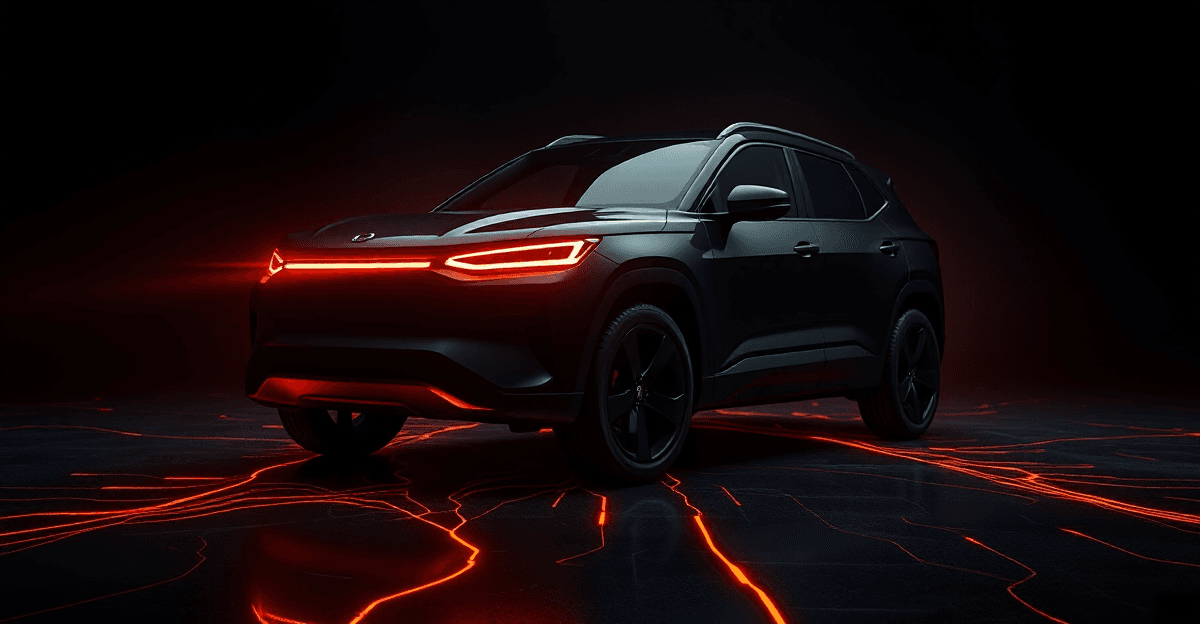
The Rivian R2 Launch and Technology Advances Create a Long-Term Opportunity
The electric vehicle industry has seen no shortage of ambitious promises, but Rivian's R2 launch represents something different — a calculated, AI-driven bet on the future of affordable mobility that carries implications far beyond the automotive sector. Where the R1T and R1S established Rivian's brand credibility in the premium segment, the R2 is the vehicle designed to prove scalability. And scalability, in 2025, is fundamentally an AI problem.
Analysts at TD Cowen have maintained a bullish outlook on NASDAQ: RIVN, citing the software-defined vehicle architecture as a key differentiator in a crowded EV market. Seeking Alpha contributors have echoed this sentiment, pointing to Rivian's platform approach — where the R2 shares foundational technology with future models — as evidence of a compound growth strategy that traditional automakers struggle to replicate. The RIVN long-term opportunity, as analysts frame it, is not simply about selling more vehicles. It's about owning the intelligence layer that sits between the driver and the road.
From a RevolutionAI perspective, this is a pattern we recognize immediately. OEMs that embed AI into their product roadmaps from day one consistently outperform those that treat software as an afterthought. The R2 launch and technology advances create a long-term opportunity not just for investors watching NASDAQ: RIVN, but for any enterprise leader asking the same foundational question: Are we building a product, or are we building an intelligent platform? Our AI consulting services are built around helping organizations answer that question before the architecture decisions become irreversible.
What to Expect From the Rivian R2 on Price — and Why AI Makes It Possible
The Rivian R2 price target has been one of the most closely watched figures in the EV industry. Forbes and multiple automotive analysts project the R2 will land below $45,000 — a significant undercut from the R1T's entry price north of $70,000. Hitting that number isn't just a manufacturing challenge; it's a data problem. And Rivian is solving it with machine learning.
AI-optimized supply chain management is doing real work here. Machine learning models trained on component pricing trends, logistics costs, and supplier performance data allow Rivian's procurement teams to make smarter decisions faster — forecasting cost fluctuations before they hit the balance sheet, dynamically adjusting sourcing strategies in real time, and identifying waste on the production line before it compounds. Industry research from McKinsey suggests that AI-driven supply chain optimization can reduce operational costs by 15–20% in complex manufacturing environments. For a vehicle targeting a sub-$45K price point, that margin recapture is the difference between a viable product and a money-losing flagship.
What's important for enterprise leaders to recognize is that this cost intelligence layer is not proprietary to the automotive world. Any manufacturer, logistics provider, or product company operating at scale can deploy similar ML-driven procurement and production models. The pattern is universal: ingest operational data, train predictive models, act on forecasts in real time. The barrier to entry has never been lower — but the execution gap between organizations that get this right and those that don't has never been wider. That's precisely where a structured AI consulting services engagement accelerates time-to-value.
AI Under the Hood: The Technology Stack Powering the R2 Platform
Rivian's in-house zonal electrical architecture is one of the more underappreciated technical achievements in modern vehicle design. Rather than distributing vehicle functions across dozens of discrete control modules — the legacy approach that creates integration nightmares and update bottlenecks — Rivian consolidates intelligence into fewer, smarter compute nodes. The result is a vehicle that behaves less like a collection of mechanical systems and more like a distributed computing platform on wheels. For anyone familiar with HPC infrastructure design, the parallel is immediate.
This architectural philosophy mirrors the principles behind enterprise AI infrastructure: reduce latency by co-locating compute and data, minimize failure points through consolidation, and design for update cycles rather than static deployment. Rivian's approach means that the R2 can receive over-the-air (OTA) software updates that meaningfully improve vehicle performance, safety, and features post-purchase — the same way enterprise AI models should be continuously retrained on live operational data rather than frozen at deployment. RevolutionAI's HPC hardware design services address exactly this class of problem for organizations building the compute backbone behind their AI workloads.
However, the OTA capability that makes the R2 such a compelling software product also expands its attack surface dramatically. A vehicle that receives firmware updates over a network connection is a vehicle that can be targeted through that same connection. Robust AI security frameworks — covering model integrity, firmware validation, adversarial input detection, and secure API endpoints — are not optional features for a software-defined vehicle. They are foundational requirements. The same is true for any enterprise deploying AI at the edge, and our AI security solutions are designed to address these vulnerabilities before they become incidents.
From POC to Production: Lessons EV Makers Teach the Enterprise AI World
Rivian's journey from a scrappy EV startup to a company launching its second-generation platform is a story of surviving the POC-to-production gap — the graveyard where most ambitious technology initiatives die quietly. The R2 didn't emerge from a single breakthrough moment. It was built on years of iterative development, architectural decisions made under pressure, and the hard-won discipline to scale what worked and abandon what didn't. Enterprise AI teams face an identical journey, and most of them don't make it.
The numbers are stark: Gartner has consistently reported that between 50–80% of enterprise AI projects fail to move beyond the pilot phase. The reasons are familiar — underfunded pilots, proof-of-concept architectures that were never designed to scale, data pipelines built for demos rather than production loads, and organizational structures that reward launching pilots over shipping production systems. Rivian's early automation tools and software stacks weren't perfect either. The difference is that Rivian had the discipline — and the investment — to rescue those systems before they became permanent technical debt. Our POC development service is built around that same discipline: designing pilots with production architecture in mind from the first commit.
The no-code rescue problem deserves specific attention here. Many automotive tech suppliers, like many enterprise teams, built early automation workflows using low-code and no-code platforms that felt fast in 2020 but became brittle by 2023. When those systems can't handle R2-era data volumes or integration complexity, the organization faces a painful choice: rebuild from scratch or patch indefinitely. RevolutionAI's no-code rescue practice exists because that choice is false. With the right expertise, those investments can be refactored into scalable, production-ready AI systems — preserving business logic while replacing the architecture that was never designed to last.
AI Security in the Age of Connected EVs: A Growing Enterprise Imperative
The Rivian R2 will be one of the most connected vehicles ever sold at its price point — integrated with charging networks, fleet management APIs, mobile applications, and third-party services. Each integration point is a potential attack vector. Researchers at institutions like Upstream Security have documented a 225% increase in automotive cyber incidents over a recent three-year period, with API attacks representing the fastest-growing attack category. The software-defined vehicle isn't just a product innovation — it's a new threat surface that the industry is still learning to defend.
Enterprise organizations adopting connected hardware face identical challenges. IoT deployments, edge AI systems, and autonomous operational technology share the same fundamental vulnerabilities as connected vehicles: insecure model endpoints, unpatched firmware, supply chain compromise through third-party components, and insufficient monitoring of runtime behavior. The threat model for a Rivian R2 fleet manager and the threat model for an enterprise deploying AI-powered industrial sensors are structurally the same problem. The tools and frameworks to address them are also converging.
Proactive AI security audits, threat modeling for ML pipelines, and zero-trust architecture are no longer aspirational best practices — they are baseline requirements for any organization deploying AI in production. Waiting for an incident to drive security investment is a strategy that consistently produces the worst outcomes at the highest cost. RevolutionAI's AI security solutions are designed to get ahead of that curve, delivering threat modeling, red-teaming for ML systems, and architectural review before vulnerabilities become breaches. In the age of connected EVs and connected enterprises, security is not a feature you add later. It's infrastructure you build first.
Managed AI Services: How Rivian's Fleet Intelligence Model Translates to Enterprise
One of the most strategically significant aspects of Rivian's business model is often overlooked in conversations focused on vehicle sales: the managed services layer. Rivian operates continuous telemetry collection, predictive maintenance alerting, and remote diagnostics across its fleet — generating recurring revenue and deepening customer relationships long after the initial transaction. This is not incidental to the business. It is increasingly central to it. The vehicle is the hardware; the intelligence layer is the product.
This is the same value proposition behind enterprise managed AI services: shifting from one-time implementation projects to ongoing intelligence delivery that compounds over time. An AI model deployed once and left static degrades as the world changes around it. An AI system continuously retrained on live operational data, monitored for drift, and updated as business conditions evolve becomes more valuable every month. Organizations that have made this transition report 3–5x higher ROI on their initial AI investments compared to those running static deployments — because the model's accuracy, and therefore its business impact, improves rather than decays.
The managed services model also changes the organizational relationship with AI. Rather than treating AI as a capital project with a defined end date, managed AI services create a continuous feedback loop between operational reality and model behavior. Rivian's fleet intelligence doesn't just tell drivers when to schedule maintenance — it feeds back into product development, informing future hardware and software decisions with real-world performance data. Enterprise organizations that adopt this model gain the same compounding advantage: AI that gets smarter as the business grows, rather than becoming obsolete as it does.
Strategic Takeaways: What RIVN's Long-Term AI Bet Means for Your Digital Transformation
The Rivian R2 launch is a case study in what it looks like when AI is treated as a first-class architectural concern rather than a feature to be added post-launch. The R2 price target is achievable because of AI-driven supply chain intelligence. The platform's longevity is secured by OTA update infrastructure. The recurring revenue model is powered by fleet AI and managed services. And the security posture required to sustain all of it demands proactive, embedded AI security from day one. Strip out the AI layer, and you don't have a competitive EV. You have an expensive prototype.
The convergence of affordable hardware, intelligent software, and managed connectivity is the same trifecta driving enterprise AI adoption across every industry. The organizations winning this transition are not necessarily the ones with the largest budgets — they are the ones that made the right architectural decisions early, built for scale rather than for demos, and treated AI security as infrastructure rather than insurance. The window to build that foundation is open now, but it is not open indefinitely. Competitors who establish AI-embedded product and operational platforms in the next 18–24 months will carry compounding advantages that become increasingly difficult to overcome.
RevolutionAI helps organizations at every stage of that journey. Whether you're evaluating your first AI pilot, rescuing a no-code implementation that has hit its ceiling, designing the HPC infrastructure to support production AI workloads, or transitioning to a managed services model that delivers continuous intelligence — the path from where you are to where Rivian is building toward is navigable with the right partner. Explore our managed AI services to understand what ongoing AI delivery looks like in practice, or connect with our team through our AI consulting services to map your specific roadmap.
Conclusion: The Road Ahead Is Software-Defined
The Rivian R2 launch and technology advances create a long-term opportunity that extends well beyond the automotive sector. What Rivian is demonstrating — at scale, in public, with real capital at stake — is that AI-embedded architecture is not a competitive advantage. It is the new baseline. The organizations that treat it as optional are not playing a different game. They are playing the same game with a structural disadvantage that compounds every quarter.
The lessons from the R2 platform are clear: design for intelligence from the first architectural decision, build security into the foundation rather than the perimeter, treat POC discipline as a production prerequisite, and shift toward managed intelligence models that grow with your business. These are not automotive lessons. They are AI lessons — and they apply with equal force to every enterprise navigating digital transformation in 2025 and beyond.
The road ahead is software-defined. The question is whether your organization's AI infrastructure is ready to drive it.
Frequently Asked Questions
What is the Rivian R2 price expected to be?
The Rivian R2 is projected to launch below $45,000, making it significantly more affordable than the R1T and R1S models that start north of $70,000. Rivian is leveraging AI-driven supply chain optimization and a shared platform architecture to hit this price target without sacrificing core technology features.
When will the Rivian R2 be available to buy?
Rivian has confirmed the R2 is in active development with production planned at its Normal, Illinois facility. While an exact on-sale date has not been officially locked in, industry analysts expect deliveries to begin in 2026 based on current manufacturing timelines.
How does the Rivian R2 differ from the R1T and R1S?
The Rivian R2 is designed as a more compact, mass-market vehicle targeting a sub-$45,000 price point, compared to the premium positioning of the R1T pickup and R1S SUV. Despite the lower price, the R2 shares foundational platform technology with Rivian's existing lineup, including its software-defined vehicle architecture and zonal electrical system.
Why is the Rivian R2 considered a long-term investment opportunity?
Analysts at firms like TD Cowen maintain a bullish outlook on RIVN because the R2 represents Rivian's scalability play — moving from a niche premium brand to a high-volume EV manufacturer. The platform approach means technology developed for the R2 compounds across future models, creating an intelligent software layer that traditional automakers struggle to replicate.
What technology powers the Rivian R2 platform?
The R2 is built on Rivian's in-house zonal electrical architecture, which consolidates vehicle intelligence into fewer, more powerful computing zones rather than relying on dozens of discrete control modules. This design enables faster over-the-air software updates, easier integration of AI-driven features, and lower long-term maintenance complexity.
Is the Rivian R2 a good choice compared to other affordable EVs?
The Rivian R2 stands out among sub-$45,000 EVs because of its software-defined platform, which is designed to improve over time through AI-powered updates rather than becoming obsolete. For buyers weighing options like the Tesla Model Y or Ford Mustang Mach-E, the R2's combination of off-road capability, platform longevity, and competitive pricing makes it a compelling alternative.