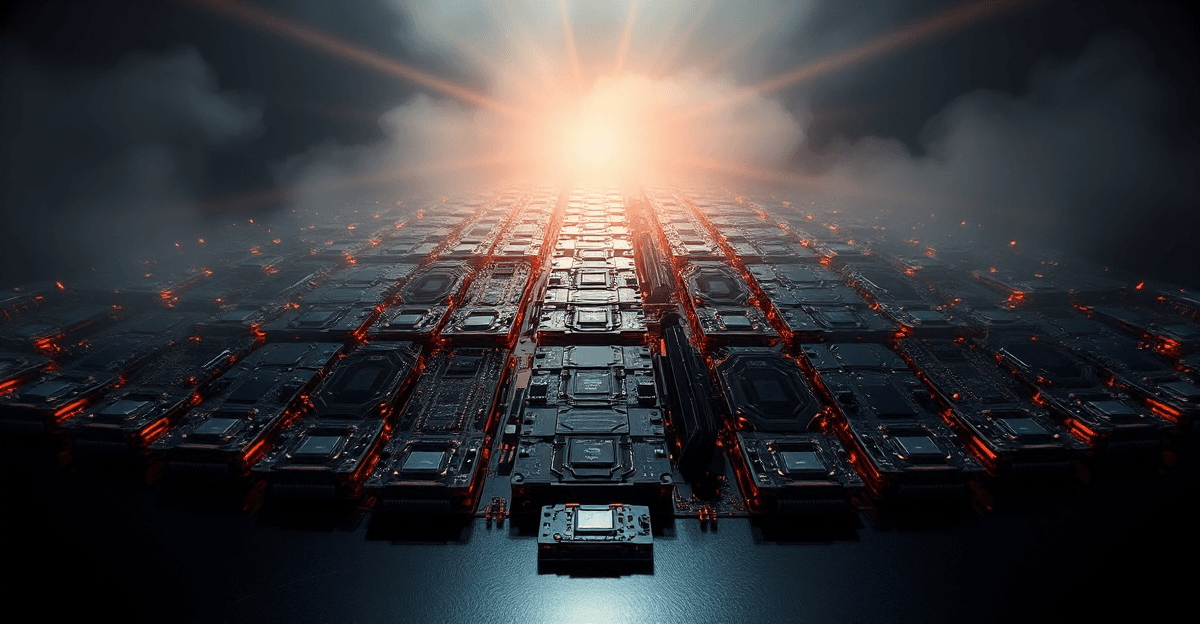
IREN Limited's Announced Purchase of 50,000 NVIDIA B300 GPUs
When IREN Limited announced its purchase of over 50,000 NVIDIA B300 GPUs in 2025, it sent a clear signal to every enterprise technology leader paying attention: the race for purpose-built AI infrastructure has entered a new, more aggressive phase. This is not a incremental hardware refresh. It is one of the largest single AI hardware commitments made by a publicly traded company in recent memory, and it carries implications that extend well beyond IREN stock performance or quarterly earnings calls.
The B300 GPUs represent NVIDIA's latest Blackwell architecture — a generational leap that delivers significant performance-per-watt improvements critical for large-scale AI workloads, from large language model training to real-time inference at the edge. Unlike previous generations, the B300 is engineered specifically for the density demands of modern AI data centers, enabling organizations to extract more compute from the same physical footprint. For IREN, this is not just a hardware bet — it is a strategic declaration that they intend to compete directly with hyperscalers for high-performance compute (HPC) workloads.
Understanding what drove this capital decision matters for enterprise leaders benchmarking their own AI hardware roadmaps. IREN's move reflects a broader conviction that owning the hardware stack — rather than renting it — creates durable competitive advantages in a market where GPU availability and pricing remain volatile. If your organization is evaluating AI fleet expansion, IREN's announced purchase is a case study worth studying closely. Our AI consulting services at RevolutionAI are designed to help enterprise leaders translate these market signals into actionable infrastructure strategies tailored to their specific workloads and budget realities.
AI Expansion and MSCI Index Inclusion: Why IREN Stock Is Trending
IREN stock has attracted significant attention in 2025, and the reasons go beyond the GPU headline. The company's recent inclusion in the MSCI Index represents a meaningful institutional validation — one that triggers automatic capital inflows from index-tracking funds, elevates IREN's profile among hedge funds and asset managers, and introduces a new class of institutional scrutiny to the company's operations. MSCI inclusion is not a trivial event; it is a structural liquidity catalyst that often precedes accelerated growth phases for emerging technology companies.
According to hedge funds tracking AI infrastructure plays, MSCI inclusion combined with a credible hardware expansion narrative creates a powerful short-term price catalyst. The dual driver of AI expansion and MSCI index inclusion fuel growth expectations in ways that can compress valuation multiples rapidly. However, this same dynamic amplifies volatility risk. When institutional flows meet retail speculation around AI stock narratives, price action can become disconnected from underlying operational fundamentals — at least in the short term.
Analysts on Seeking Alpha have flagged a significant concern: a massive at-the-money (ATM) filing by IREN creates potential dilution risk that sits in direct tension with the bullish infrastructure narrative. This is a recurring tension in high-growth AI infrastructure companies — the capital required to build out GPU fleets at scale often necessitates equity issuance, which can weigh on per-share value even as the underlying business grows. For investors and enterprise leaders alike, separating the stock story from the infrastructure story is essential for making sound decisions.
Deploying Additional GPUs in Phases: The Operational Reality
IREN's company aims to deploy these additional GPUs across phases through 2026, scaling data center capacity in tranches rather than committing to a single massive buildout. This phased deployment strategy across multiple data centers is not just financially prudent — it is operationally essential. Deploying 50,000 B300 GPUs simultaneously would create extraordinary pressure on cooling infrastructure, power delivery systems, and networking fabric. Phased rollouts allow engineering teams to identify bottlenecks, optimize configurations, and course-correct before problems compound at scale.
The 2026 across-phase deployment model also reduces single-point-of-failure risk. By distributing GPU capacity across multiple data center locations, IREN builds geographic and infrastructure redundancy into its AI fleet from the ground up. For enterprises planning their own AI fleet expansion, this is a critical design principle that is frequently underestimated. Organizations often focus on GPU procurement lead times while underinvesting in the power, cooling, and networking readiness required to actually utilize that hardware at full capacity.
Enterprises evaluating large-scale GPU infrastructure commitments should study IREN's phased rollout as a practical blueprint. The key insight is that GPU deployment is not a single event — it is a multi-quarter operational program requiring coordination across procurement, facilities, networking, and software teams. RevolutionAI's managed AI services practice specializes in helping organizations architect phased GPU deployment strategies that align with budget cycles, operational readiness milestones, and measurable business outcomes. We bring real deployment experience to engagements, not theoretical frameworks.
What the B300 GPU Move Tells Us About the Future of AI Data Centers
The B300 GPUs move the industry needle on AI inference and training density in ways that will reshape how enterprises think about AI data centers for years to come. NVIDIA's Blackwell B300 architecture enables significantly more tokens per second per rack than any previous generation — a metric that matters enormously for organizations running large language models at production scale. When you are serving millions of inference requests daily, the difference between architectures is not incremental; it compounds into substantial cost and latency advantages.
IREN's investment underscores a broader market trend that has been building for several years: purpose-built AI data centers are displacing general-purpose cloud compute for latency-sensitive and cost-sensitive AI workloads. Hyperscalers built their infrastructure for broad-purpose compute — web serving, databases, batch processing. The requirements of modern AI workloads — high-bandwidth memory, NVLink fabric, liquid cooling, ultra-low-latency interconnects — are fundamentally different. Specialized AI fleet providers like IREN are architecting from the ground up for these requirements, which creates structural cost and performance advantages over retrofitted general-purpose infrastructure.
Energy efficiency is a core driver of this shift, and the B300 architecture's improvements in performance-per-watt translate directly into total cost of ownership reductions for large language model training and real-time inference at scale. Organizations evaluating AI infrastructure in 2025 and beyond should conduct a rigorous analysis of whether colocation with specialized AI fleet providers offers better economics than hyperscaler GPU rentals for their specific workloads. The answer is not universal — it depends on utilization rates, workload profiles, and operational maturity — but the question is now worth asking seriously. Our AI consulting services can help you model these trade-offs with precision.
Separating AI Stock Hype From Real Digital Transformation Value
IREN stock's volatility illustrates a pattern that has become familiar in the AI investment cycle: hardware announcements drive significant short-term price action, but long-term value creation depends on utilization rates, margin expansion, and the ability to convert GPU capacity into recurring revenue streams. A company can own 50,000 of the world's most powerful AI processors and still destroy shareholder value if those processors sit underutilized or are monetized at below-cost rates in a competitive pricing environment.
The "get rich quick" narrative that often surrounds AI infrastructure stocks obscures the genuine operational complexity of deploying and monetizing GPU fleets at scale. Building a profitable AI data center business requires expertise in power procurement, thermal management, high-speed networking, software orchestration, and customer success — disciplines that are not acquired overnight and cannot be outsourced entirely. Investors and enterprise leaders alike must develop the analytical discipline to distinguish between companies building durable AI infrastructure moats through genuine operational excellence and those making headline GPU purchases without clear demand pipelines to justify the capital commitment.
For enterprise technology leaders, the more important question is not whether IREN stock will outperform in the next quarter — it is what IREN's infrastructure strategy reveals about the direction of the market and how your organization should respond. RevolutionAI's AI consulting services help organizations cut through market noise to identify infrastructure investments that deliver measurable ROI rather than speculative upside. We help you ask the right questions before capital is committed, not after.
Strategic Lessons for Enterprises Planning Their Own AI Fleet Expansion
IREN's model demonstrates a principle that is increasingly validated across the AI infrastructure landscape: vertical integration of GPU ownership, data center operations, and AI services creates competitive advantages that are simply unavailable to pure-play cloud consumers. When you own the hardware stack, you control the economics, the performance envelope, and the roadmap. You are not subject to hyperscaler pricing decisions, availability constraints, or product discontinuations that can disrupt your AI programs at the worst possible moments.
However, vertical integration at IREN's scale requires capital, expertise, and operational infrastructure that most enterprises cannot replicate internally. The strategic lesson is not that every organization should buy 50,000 GPUs — it is that enterprises should conduct rigorous proof-of-concept work before committing to any large-scale GPU infrastructure investment. A well-designed POC validates workload fit, latency requirements, throughput characteristics, and total cost of ownership before significant capital is deployed. Organizations that skip this step frequently discover expensive mismatches between their AI workloads and their chosen infrastructure after contracts are signed and hardware is racked. RevolutionAI's POC development services are specifically designed to de-risk exactly these decisions for mid-market and enterprise clients.
AI security must also be embedded into hardware procurement decisions from day one — a dimension that is frequently treated as an afterthought in the excitement of fleet expansion. Large GPU clusters introduce new attack surfaces that are distinct from traditional IT security concerns, including model theft, data exfiltration through inference APIs, supply chain risks in hardware procurement, and adversarial attacks on training pipelines. Enterprises planning significant AI infrastructure investments should engage security expertise early in the procurement process. Our AI security solutions practice helps organizations build security architecture that scales with their GPU infrastructure, not after it.
How RevolutionAI Helps You Navigate the GPU Infrastructure Landscape
Whether you are evaluating HPC hardware design options, assessing colocation with AI fleet providers like IREN, or building internal GPU capacity for proprietary workloads, the decisions you make in 2025 will shape your organization's AI capabilities for the next three to five years. The market is moving quickly, hardware generations are compressing, and the gap between organizations that get AI infrastructure right and those that do not is widening. Vendor-neutral, experience-grounded guidance has never been more valuable.
RevolutionAI's managed services practice provides continuous monitoring of GPU utilization, model performance metrics, and infrastructure health — ensuring that your AI investment delivers ongoing business value rather than becoming idle compute that erodes ROI. We have seen too many organizations make significant GPU investments only to discover that utilization rates hover below 40% because the software orchestration, model serving infrastructure, and operational processes were not ready to absorb the capacity. Our managed AI services practice closes that gap, turning hardware capacity into measurable business outcomes.
From initial strategy development through to production deployment and ongoing optimization, RevolutionAI's end-to-end platform bridges the gap between AI stock headlines and actionable enterprise digital transformation. We also offer access to specialized AI talent through our freelance marketplace — connecting you with practitioners who have hands-on experience deploying GPU infrastructure at scale, building model serving pipelines, and architecting AI systems that perform in production. If you are ready to map your AI infrastructure roadmap against emerging market signals like IREN's B300 GPU expansion, we invite you to schedule a discovery session with our team to determine the right path for your organization.
Conclusion: What IREN's B300 Bet Means for the Future of Enterprise AI
IREN Limited's commitment to over 50,000 NVIDIA B300 GPUs is more than a financial headline — it is a data point that reveals the direction of the entire AI infrastructure market. The convergence of purpose-built AI data centers, next-generation GPU architecture, phased deployment discipline, and vertical integration is defining a new competitive landscape that every enterprise technology leader needs to understand.
The organizations that will lead in AI over the next decade are not necessarily those with the largest GPU budgets — they are those that combine strategic clarity about their AI workloads, disciplined infrastructure investment, rigorous security posture, and the operational expertise to translate hardware capacity into business value. IREN's bet on the B300 tells us that the era of treating AI compute as a commodity cloud service is giving way to an era of strategic infrastructure ownership. The question for enterprise leaders is not whether this shift is happening — it clearly is — but whether your organization is positioned to benefit from it or constrained by it.
The signals are in the market. The infrastructure is being built. The window to establish durable AI infrastructure advantages is open now, but it will not remain open indefinitely. RevolutionAI is here to help you act on these signals with precision, discipline, and the technical depth that separates transformative AI investments from expensive experiments.
Frequently Asked Questions
What is driving IREN stock growth in 2025?
IREN stock is gaining momentum in 2025 due to two primary catalysts: the company's announced purchase of over 50,000 NVIDIA B300 GPUs and its inclusion in the MSCI Index. The MSCI inclusion triggers automatic capital inflows from index-tracking funds while the GPU acquisition signals IREN's intent to compete directly with hyperscalers for high-performance AI compute workloads. Together, these developments have elevated IREN's profile among institutional investors and hedge funds tracking AI infrastructure plays.
Why is IREN stock considered a high-volatility AI infrastructure investment?
IREN stock carries elevated volatility risk because institutional index-driven capital flows are combining with retail speculation around AI narratives, which can disconnect price action from underlying operational fundamentals. Analysts have also flagged a significant at-the-money ATM equity filing that creates dilution risk, a common tension for companies funding large-scale GPU fleet buildouts. Investors should carefully separate the long-term infrastructure story from short-term stock price momentum before making capital allocation decisions.
What are the NVIDIA B300 GPUs IREN purchased and why do they matter?
The NVIDIA B300 GPUs are built on NVIDIA's latest Blackwell architecture, delivering significant performance-per-watt improvements specifically engineered for modern AI data center density demands. IREN's purchase of over 50,000 of these units represents one of the largest single AI hardware commitments made by a publicly traded company in recent memory. This hardware positions IREN to handle large language model training and real-time inference workloads at a scale that competes directly with major hyperscalers.
How is IREN deploying its new GPU infrastructure?
IREN plans to deploy its 50,000-plus NVIDIA B300 GPUs in phased tranches across multiple data centers through 2026, rather than executing a single massive buildout. This phased deployment strategy reduces financial risk and allows the company to scale capacity in alignment with actual workload demand and capital availability. The approach reflects a financially prudent method of managing one of the largest AI hardware investments in the sector.
When did IREN get included in the MSCI Index and what does it mean for investors?
IREN's MSCI Index inclusion occurred in 2025 and represents a significant institutional validation milestone for the company. Inclusion automatically triggers capital inflows from index-tracking funds and introduces a new class of institutional scrutiny, often acting as a structural liquidity catalyst that precedes accelerated growth phases for emerging technology companies. For investors, this event meaningfully increases IREN's visibility among hedge funds and asset managers evaluating AI infrastructure plays.
What are the main risks investors should consider before buying IREN stock?
The primary risks associated with IREN stock include dilution risk from a significant at-the-money ATM equity filing, which is often necessary to fund large-scale GPU acquisitions but can weigh on per-share value. Additionally, the combination of institutional index flows and retail AI speculation can cause price action to become temporarily disconnected from actual operational performance. Investors should evaluate both the long-term infrastructure thesis and these near-term financial structure concerns before committing capital.