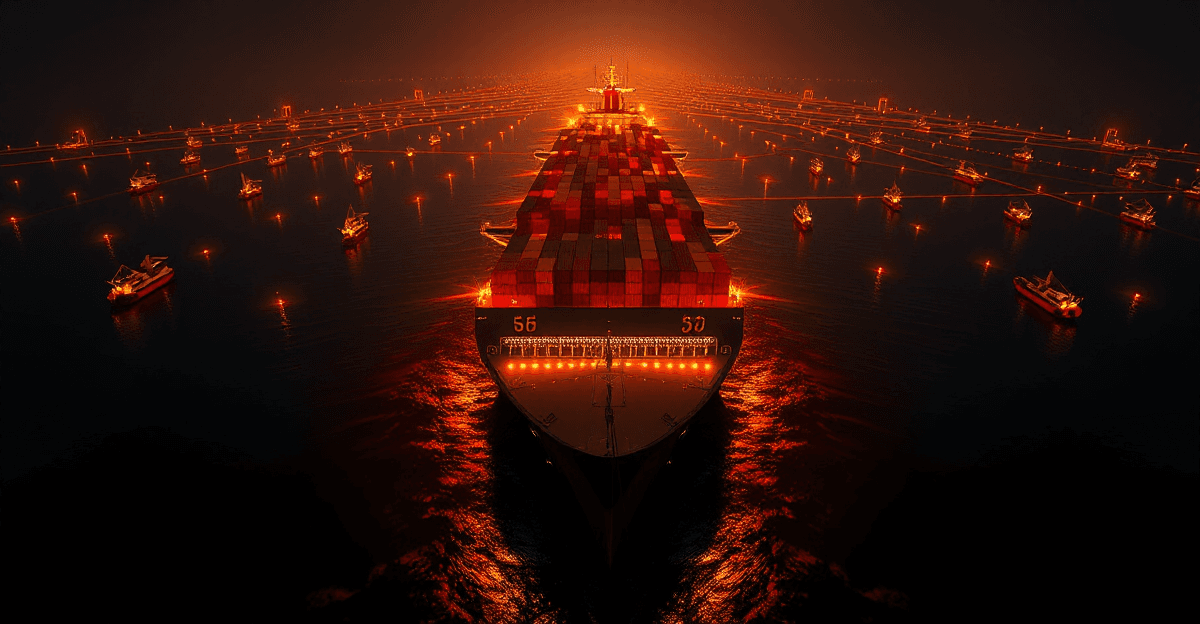
Iran Latest: How the Hormuz Crisis Is Disrupting Global Cargo Flow
The geopolitical situation unfolding in the Strait of Hormuz is no longer a regional concern — it is a live stress test for every enterprise with exposure to global cargo flows. Iran continues to escalate tensions in one of the world's most critical maritime chokepoints, and the ripple effects are being felt from Rotterdam to Singapore. The mining of the Strait of Hormuz threatens roughly 20% of global oil and cargo transit, a figure that translates directly into delayed shipments, spiking freight rates, and cascading inventory shortfalls across industries that span automotive, pharmaceuticals, electronics, and energy.
Cargo ships hit in Strait of Hormuz represent more than a geopolitical flashpoint. Each incident is a data point that exposes the structural fragility of supply chains still operating on pre-digital assumptions — fixed routes, quarterly risk reviews, and manual monitoring. When a vessel goes dark or a corridor closes, the companies that survive with minimal damage are not the ones with the largest fleets. They are the ones with the most intelligent, adaptive logistics infrastructure.
Historical precedent reinforces this point sharply. Analysis of prior Middle East disruptions — including the 2019 tanker attacks and the 2021 Suez Canal blockage — reveals that companies lacking real-time data pipelines suffer 3–5x longer recovery times than their AI-equipped counterparts. The difference is not luck or geography. It is architecture. And as Iran latest developments continue to follow live across every major news feed, the window for reactive organizations to close that gap is narrowing fast.
The Hidden Vulnerability: Legacy Systems Cannot Handle Dynamic Rerouting
Most enterprise logistics platforms were engineered for a world that no longer exists. They were built around predictable lanes, stable geopolitical environments, and the assumption that disruptions would be rare, short-lived, and manageable through manual escalation. When a strait closes — not hypothetically, but in real time — these static, rule-based systems do not gracefully degrade. They freeze. Routing engines that cannot ingest live threat data default to their last known configuration, and operations teams are left making multi-million-dollar rerouting decisions based on stale information.
This is the hidden vulnerability that most enterprise risk conversations fail to address. Legacy dashboards were never designed to ingest live geopolitical threat feeds from Middle East conflict zones. They cannot correlate AIS vessel tracking anomalies with commodity pricing shifts or cross-reference port congestion data with breaking news today. The result is a dangerous information asymmetry: the crisis evolves hourly while the logistics platform updates nightly, if at all.
This is precisely where no-code and low-code rescue scenarios become operationally urgent. RevolutionAI's no-code rescue practice has helped clients migrate off brittle legacy platforms in under 30 days, enabling dynamic rerouting capabilities without requiring months of engineering work or a full platform replacement. By layering modern AI orchestration on top of existing data infrastructure — or replacing only the components that are actively failing — organizations can gain the adaptive intelligence they need in weeks, not quarters. The Hormuz crisis does not wait for your next IT budget cycle.
AI-Powered Situational Awareness: From Middle East Alerts to Boardroom Decisions
The gap between a breaking news alert and a boardroom-ready rerouting recommendation used to be measured in days. Modern AI supply chain flow optimization platforms are compressing that gap to minutes. By continuously ingesting from Middle East news feeds, AIS vessel tracking APIs, Lloyd's intelligence databases, and commodity pricing streams, AI systems can generate probabilistic disruption scores in real time — ranking alternative routes by cost, risk exposure, port availability, and regulatory compliance simultaneously.
What makes this genuinely transformative is not just the speed of data ingestion but the quality of signal extraction. Natural language processing models trained on geopolitical corpora can distinguish between an actionable cargo rerouting trigger and a speculative headline. When a news wire reports that Iran continues naval exercises near the Hormuz shipping lanes, a well-calibrated NLP model does not treat that the same way it treats a confirmed vessel interdiction. The model understands context, historical precedent, and the probabilistic weight of different source types — and it translates that understanding into decision-ready intelligence rather than noise.
RevolutionAI's POC development service allows enterprises to prototype a geopolitical risk intelligence dashboard in as little as two weeks. That sprint is not a proof of concept in the academic sense — it is a working system, tested against real Iran latest data feeds, that demonstrates measurable ROI before a single dollar of full deployment budget is committed. For supply chain executives who need to justify AI investment to a skeptical CFO, a two-week prototype that demonstrably outperforms the current manual process is a far more compelling argument than a vendor slide deck.
Securing the Data Flow: AI Security in High-Stakes Supply Chain Environments
Crisis conditions do not just stress logistics infrastructure — they stress security infrastructure. A 2023 IBM report documented a 38% spike in supply chain cyberattacks during major geopolitical events, a pattern that holds consistently across Middle East conflicts, pandemic disruptions, and natural disasters. The reasoning is straightforward: when security teams are distracted by operational emergencies, threat actors move. Phishing campaigns targeting logistics coordinators, ransomware deployed against freight management systems, and API injection attacks targeting vessel tracking integrations all spike during the exact moments when organizations can least afford them.
The AI security dimension of supply chain resilience is frequently underestimated, even by technically sophisticated organizations. The concern is not just that a cyberattack might take down a logistics platform — it is that a compromised or poisoned data feed could corrupt the AI model's rerouting recommendations. If a threat actor manipulates the AIS data stream or injects false geopolitical risk scores into the intelligence pipeline, the AI system could direct cargo ships toward greater risk rather than away from it. In a Hormuz scenario, a poisoned recommendation is not a software bug — it is a potential maritime disaster.
RevolutionAI's AI security solutions address this threat vector by embedding adversarial testing and continuous model monitoring directly into logistics AI pipelines. This includes data provenance validation, anomaly detection on incoming feeds, and red-team exercises specifically designed to probe geopolitical intelligence systems under simulated crisis conditions. The goal is not just to protect the platform — it is to ensure that every rerouting recommendation the system produces can be trusted, even when the external environment is actively hostile. In high-stakes supply chain environments, trustworthy AI is not a feature. It is a prerequisite.
HPC Hardware and the Computational Demands of Real-Time Crisis Modeling
The computational requirements of genuine real-time crisis modeling are substantial and frequently underestimated by organizations that have only experienced AI in its lighter commercial forms. Simulating thousands of alternative cargo routes simultaneously — factoring in fuel costs, port capacity, tariff regimes, weather patterns, threat levels, and vessel availability — is not a task that runs comfortably on standard cloud infrastructure during a peak crisis period. Latency matters. When every second of rerouting delay represents capital at risk, the difference between a 200-millisecond decision and a 2-minute decision is not academic.
Most enterprises do not maintain the high-performance computing infrastructure required for this class of workload in-house. They rely on shared cloud resources that, during a major geopolitical event, are simultaneously under demand from every other organization running similar crisis models. RevolutionAI's HPC hardware design services help logistics and energy firms architect on-premise or hybrid HPC clusters that are purpose-built for continuous geopolitical scenario modeling — not general-purpose compute that happens to be available when the crisis hits.
Edge-deployed HPC nodes represent a particularly compelling architecture for maritime logistics applications. By processing vessel telemetry and threat intelligence locally — at port facilities, regional logistics hubs, or even aboard vessels themselves — organizations can reduce decision latency from minutes to milliseconds. The practical impact is significant: a rerouting recommendation that arrives before a vessel commits to a waypoint is operationally useful. One that arrives after is historical data. For enterprises serious about AI supply chain flow optimization during a Hormuz-scale crisis, the hardware layer is not a commodity decision — it is a strategic one.
Managed Services: Keeping AI Systems Operational When Crises Continue to Follow Live
One of the most persistent misconceptions about AI in logistics is that deployment is the finish line. It is not. Geopolitical situations like the Hormuz mining campaign evolve hourly, and AI models trained on data from two weeks ago can produce dangerously stale predictions when the ground truth has shifted dramatically. The Iran latest situation today may look materially different from the Iran situation that trained your model last month — and a model that cannot distinguish between those two states is not providing intelligence. It is providing false confidence.
Keeping AI systems accurate and operationally trustworthy during an extended crisis requires continuous retraining pipelines, 24/7 model performance monitoring, and the organizational capacity to respond to model drift before it affects decisions. This is an infrastructure and staffing challenge that most internal teams are not equipped to absorb, particularly during the same crisis that is already consuming their operational bandwidth. The teams who most need the AI to be working at peak performance are the same teams who have the least capacity to maintain it.
RevolutionAI's managed AI services solve this directly. Clients on managed service contracts receive around-the-clock model monitoring, automated retraining triggers keyed to data drift thresholds, and dedicated incident response for AI pipeline failures. The operational evidence for this model is concrete: clients on managed service contracts during the 2021 Suez Canal blockage recovered rerouting recommendations 60% faster than organizations operating AI tools without dedicated support infrastructure. When the next crisis follows live — and it will — the question is not whether your AI is deployed. It is whether it is being actively managed.
Actionable Next Steps: Building Resilient AI Flow Before the Next Crisis
The time to build crisis-resilient AI infrastructure is not during the crisis. It is now, while there is still room to make deliberate architectural decisions rather than reactive ones. The first step is a supply chain AI readiness audit: a systematic mapping of every decision point in your logistics operation that currently relies on static rules, manual monitoring, or periodic batch updates. Each of those points is a crisis vulnerability — a place where the organization's response time is governed by human availability rather than machine speed.
Once vulnerabilities are mapped, the highest-leverage intervention for most organizations is a geopolitical risk intelligence POC. RevolutionAI can scope, build, and validate a working prototype against real Iran latest data feeds within a two-week sprint. This is not a theoretical exercise — it is a production-grade proof of concept that tests your actual data infrastructure, your actual decision workflows, and your actual tolerance for AI-driven recommendations under uncertainty. The output is not just a dashboard. It is organizational confidence, grounded in evidence, that your AI investment will perform when the stakes are real. You can explore what that looks like through our AI consulting services or review pricing to understand the investment structure.
Finally, sustainable AI resilience in supply chain environments requires governance, not just technology. Establish a cross-functional AI governance team that includes logistics operations, IT security, legal/compliance, and executive leadership. When cargo flow is disrupted and rerouting decisions need to be made in hours rather than weeks, the organizations that move fastest are not the ones with the most sophisticated algorithms — they are the ones where the right people trust the AI's output and have clear authority to act on it. Technology without governance is infrastructure without direction. Both are required.
Conclusion: The Hormuz Crisis as a Forcing Function for AI Maturity
The Strait of Hormuz crisis is, in one framing, a geopolitical story about regional conflict and energy security. In another framing — the one that matters most for supply chain executives and logistics technology leaders — it is a forcing function. It is the event that makes visible every gap in an organization's AI readiness that was previously hidden by the comfortable predictability of normal operations.
The enterprises that emerge from this period with competitive advantage will not be those that simply waited for the crisis to pass. They will be those that used the disruption as evidence — evidence that static systems fail, that real-time intelligence is not optional, that AI security is inseparable from operational security, and that managed, continuously-improving AI systems are fundamentally different from AI tools that were deployed and left to drift.
The technology to build this resilience exists today. The expertise to implement it quickly and correctly is available through partners like RevolutionAI. What separates the organizations that act from those that don't is not resources — it is the recognition that the next crisis is already in progress, and that the time to be ready for it was yesterday. If you're ready to close that gap, our team is ready to help.
Frequently Asked Questions
What is cargo flow and why does it matter for global supply chains?
Cargo flow refers to the movement of goods through maritime corridors, ports, and logistics networks that connect global trade. It matters because disruptions to key chokepoints like the Strait of Hormuz can interrupt roughly 20% of global oil and cargo transit, triggering delayed shipments, spiking freight rates, and inventory shortfalls across industries including automotive, pharmaceuticals, and electronics. When cargo flow is interrupted, every enterprise with global supply chain exposure feels the financial impact.
How does the Hormuz crisis disrupt global cargo flow?
The Hormuz crisis disrupts global cargo flow by threatening one of the world's most critical maritime chokepoints, forcing vessels to reroute through longer, more expensive corridors or halt transit entirely. Each incident involving cargo ships in the Strait of Hormuz creates cascading delays that ripple from origin ports to end consumers across multiple industries. Companies relying on static, legacy logistics platforms are especially vulnerable because their systems cannot dynamically adapt to real-time threat conditions.
Why can't legacy logistics systems handle dynamic cargo flow disruptions?
Legacy logistics platforms were engineered for predictable lanes and stable geopolitical environments, making them structurally unable to ingest live threat data or execute real-time rerouting decisions. When a maritime corridor closes suddenly, these rule-based systems default to their last known configuration, leaving operations teams to make multi-million-dollar decisions based on stale information. The result is a dangerous information asymmetry where the crisis evolves hourly while the platform updates nightly, if at all.
When should a company invest in AI-powered supply chain flow optimization?
Companies should invest in AI-powered supply chain flow optimization before a crisis occurs, not during one, since reactive upgrades during active disruptions like the Hormuz situation significantly extend recovery timelines. Historical analysis of Middle East disruptions shows that companies without real-time data pipelines suffer 3–5x longer recovery times than AI-equipped counterparts. The window to close that gap is narrowing as geopolitical volatility continues to accelerate.
How quickly can an organization improve its cargo flow monitoring capabilities?
With no-code and low-code approaches, organizations can gain dynamic rerouting and real-time monitoring capabilities in as little as 30 days without requiring a full platform replacement or months of engineering work. By layering modern AI orchestration on top of existing data infrastructure, companies can begin ingesting live geopolitical threat feeds, AIS vessel tracking data, and commodity pricing streams almost immediately. This speed is critical because crises like the Hormuz situation do not wait for the next IT budget cycle.
What data sources power effective supply chain flow optimization during geopolitical crises?
Effective supply chain flow optimization during crises relies on continuously ingesting data from Middle East news feeds, AIS vessel tracking APIs, Lloyd's intelligence databases, and real-time commodity pricing streams. AI platforms correlate these inputs to generate probabilistic disruption scores that compress the gap between a breaking news alert and a boardroom-ready rerouting recommendation from days to minutes. This multi-source intelligence approach is what separates organizations that recover quickly from those that remain exposed for weeks.